Why van size and dimensions matter.

When choosing a van, it’s vital to know its exact size and dimensions to ensure it can perform the tasks your business requires. What type of cargo is it going to be carrying? What kind of roads will it need to navigate? Where will it need to be parked? What does its load capacity need to be? And what regulations does it need to comply with, both within your industry and beyond?

Of course, the size of your van will also impact its fuel efficiency, manoeuvrability and overall operational efficiency within your business.

A low-angle view of the front wheel of a blue Mercedes-Benz van positioned over a large yellow arrow pointing forward.

The different types of Mercedes-Benz vans available.

The Mercedes-Benz vans range splits into three overall size categories. Within each category, there are further size and configuration options to meet a wide range of commercial applications and needs.

Understanding Mercedes-Benz van dimensions and measurements.

Three of the most important dimensions when choosing a van for your business are length, height and payload capacity. Getting these wrong could have an adverse effect on the operational efficiency of your business.

Lengths

Your van’s length, combined with its loadspace, will affect how easily it navigates tight spaces. So balancing cargo capacity with manoeuvrability is essential, especially if you operate largely in urban areas.

Height

If you need to transport bulkier cargo, larger equipment, or even work from the back of your van, then a higher roof will be advantageous. However, that needs to be balanced with the potential for a high-top van to be less aerodynamic and therefore less fuel efficient.

Payload capacity

Payload refers to the maximum weight that a van can carry, including passengers, cargo and fuel. If you’re transporting heavy or bulky items, then a van with a large payload capacity is essential. However, it’s important to factor in the operational costs of running a large payload vehicle, both in terms of fuel costs and maintenance.

A silver Mercedes-Benz van driving through a semi-covered car park with concrete pillars and a grass verge.

Why wheelbase matters.

It’s important to choose the correct wheelbase for your van, depending on its intended usage and driving environment. Here are a few things to consider when choosing between long and short wheelbase vans:


Long wheelbase (LWB)

• A larger storage area
– useful if you’re having to transport large tools and equipment.
• A more comfortable drive – the extra space between the axles on an LWB vehicle can help to smooth out bumps in the road.


Short wheelbase (SWB)

• Easier to manoeuvre – if your business involves lots of urban drop-offs, then an SWB vehicle will be easier to navigate and park around town.
• A ‘sportier’ drive – an SWB vehicle can feel a bit more ‘car-like’ in its handling compared to a long wheelbase van.

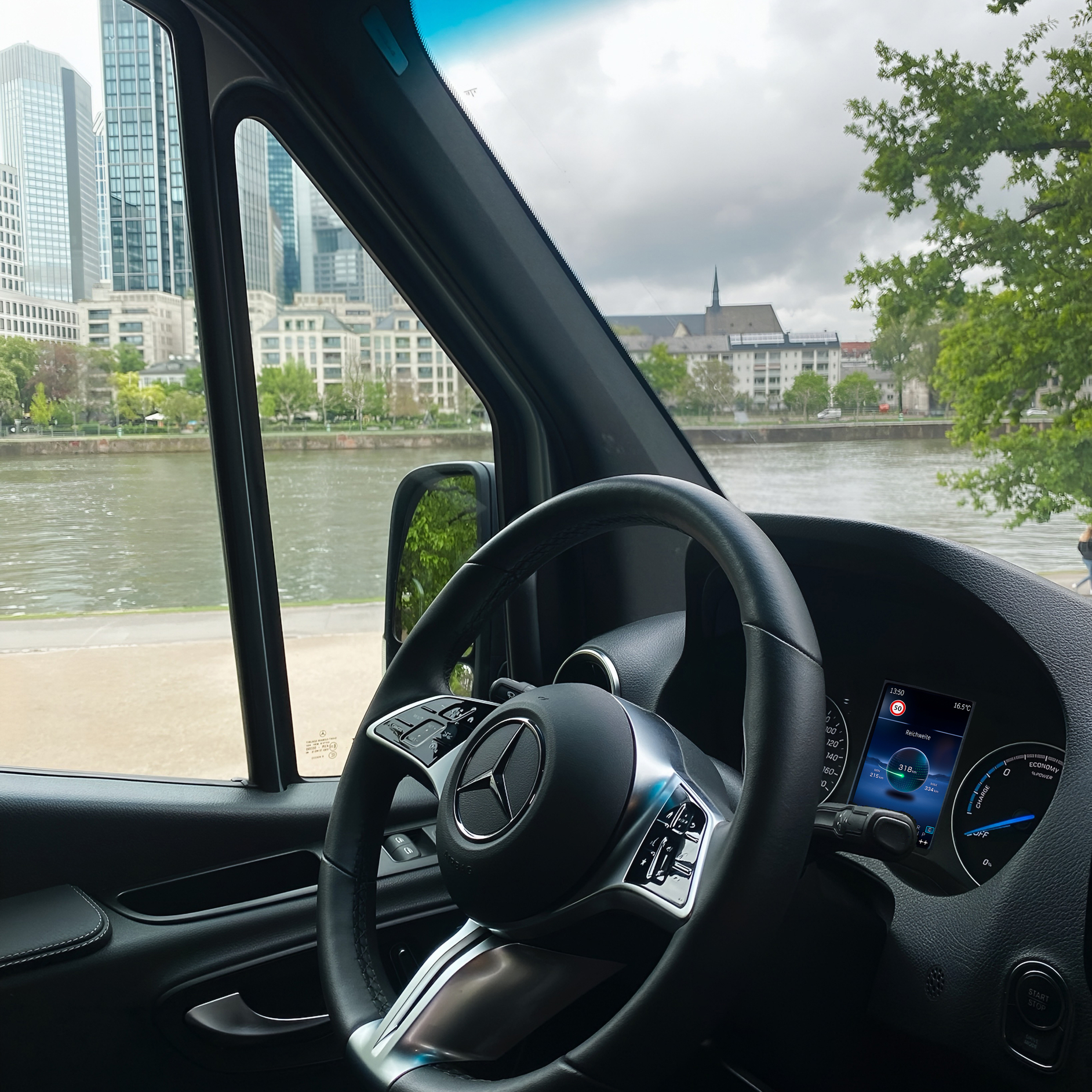
The cabin interior of a Mercedes-Benz van showing the dashboard, steering wheel, and a city skyline through the windscreen.

The different Mercedes-Benz van dimensions available

Mercedes-Benz Sprinter Panel Van.

The Sprinter range offers diverse sizes and configurations to meet varying cargo and transport demands. From standard height, SWB options suitable for urban driving and small to medium loads, to high-roof, LWB versions that are perfect for large capacity, long-haul deliveries.

Typical dimensions are:

Mercedes-Benz Vito Panel & Crew Van.

The Vito range offers SWB and LWB versions across a consistent roof height, making it perfect for both low-volume, urban deliveries, and trades that need to get a variety tools and equipment on site. There’s also a crew van option with the space to transport larger teams in comfort.

Mercedes-Benz Citan Panel Van.

The Citan offers a compact and versatile solution for a wide variety of urban commercial and delivery needs. Further flexibility is provided by twin rear doors or sliding side door options, plus interior shelving systems and roof racks.

Configure your Mercedes-Benz van.

Every business is unique. In fact, we’ve shown how van dimensions are critical when it comes to specifying the correct vehicle to fit your individual business needs.

We’ve summarised the main model options within the Mercedes-Benz van range. Now use our online van configurator to customise your chosen model in terms of length, height, wheelbase, load area and payload so that it fits your needs perfectly,

A view from the driver's seat showing the steering wheel and a city river and skyline through the window.

Find the perfect Mercedes-Benz van for your needs.

Once you’ve specified the exact requirements for your van, visit our Online Showroom to discover the model options we currently have available.

Alternatively, one of our trusted Dealers will be happy to call you, to discuss your specific requirements. Whichever van you choose, you’ll enjoy the same quality and reliability you’d expect from Mercedes-Benz.

Frequently asked questions.

We get it. There are so many options and different things to consider when buying a van for your business that it can get a bit overwhelming. The best place to start is our Van Buying Guide. It’ll walk you through the decision-making process step-by-step.

A high-roof van, like the Mercedes-Benz Sprinter H2 at just over 2.7m, will obviously give you more cargo space. It may also make loading and unloading easier. However, if you’re doing a lot of urban driving, you’ll need to factor in that it may not be able to negotiate low clearance areas, such as some car parks.

A long wheelbase vehicle will generally provide more load-carrying capacity and may even give you a more comfortable ride over uneven surfaces. Whereas a short wheelbase van will be easier to manoeuvre in tight, urban spaces and have better handling on open roads.

Your van’s payload is the maximum weight that it can safely carry, in addition to its own weight. It includes cargo, passengers, and any other equipment needed for the vehicle's operation.

It can be expressed as a simple equation: payload capacity = gross vehicle weight (GVW) – kerb weight

It’s illegal to exceed your van’s payload limit, as it can cause unstable handling and potential accidents. It can also damage the structure of your vehicle.

Available heights in the Vito range are between 1908mm and 1916mm. So, assuming no modifications have been made to the vehicle, the minimum safe clearance would be around 2000mm.