Everything you need to know about electric vehicles for your business

Switching to electric could be a game-changing move for your business – but we know it’s a big decision to make.


That’s why we have created this electric van guide designed to give you all the answers you need and help you understand the full picture – not only about our vans’ capabilities but also about the wider infrastructure, how the battery works and the suitability of electric vans for your business right now.
What are the advantages of an electric van?

When it comes to your business, you need to know you’re making the right choices for efficiency, costs and driver satisfaction. If you’re unsure where to start, you can begin by debunking common EV myths before exploring how going electric can help.

Electric vehicles are better for the environment, because they don’t produce any CO2 or NOx emissions.

Electricity costs less than diesel fuels, making electric vans far cheaper to run per mile.

Electric vans have fewer moving parts than traditional vehicles, and they’re also not as hard on their brakes, making them cheaper and easier to maintain.

The batteries of electric vans are generally stored in the underbody of the vehicle, so there’s nothing taking up space inside.

The government is helping subsidise the transition to electric with financial benefits that help towards both the purchase price and operating costs including road tax and congestion charges.

Key considerations when buying an electric van

Understanding range and battery life in electric vans

What happens to my van’s battery at the end of its life? Can it be recycled?
Once your electric van’s battery has lost its capacity to power your vehicle, it can still be used to power your home or outbuildings by contributing to a battery storage system, or even by being paired with renewable energy sources like wind or solar power.
 

Beyond this, many of the materials inside an electric battery can be recycled – and as government continues to support and encourage the use of electric vehicles, the cost of a new battery may be less than you might expect.

Do Mercedes-Benz electric vehicles come with battery warranty?

All new Mercedes-Benz electric vans come with an 8-year or 100,000 miles battery capacity warranty, and are expected to maintain at least a 70% capacity beyond this time.

How far can my electric van travel on a single charge?

All our electric vans are capable of making 96% of the average driver’s daily journeys – but the exact range depends on the make and model you choose.

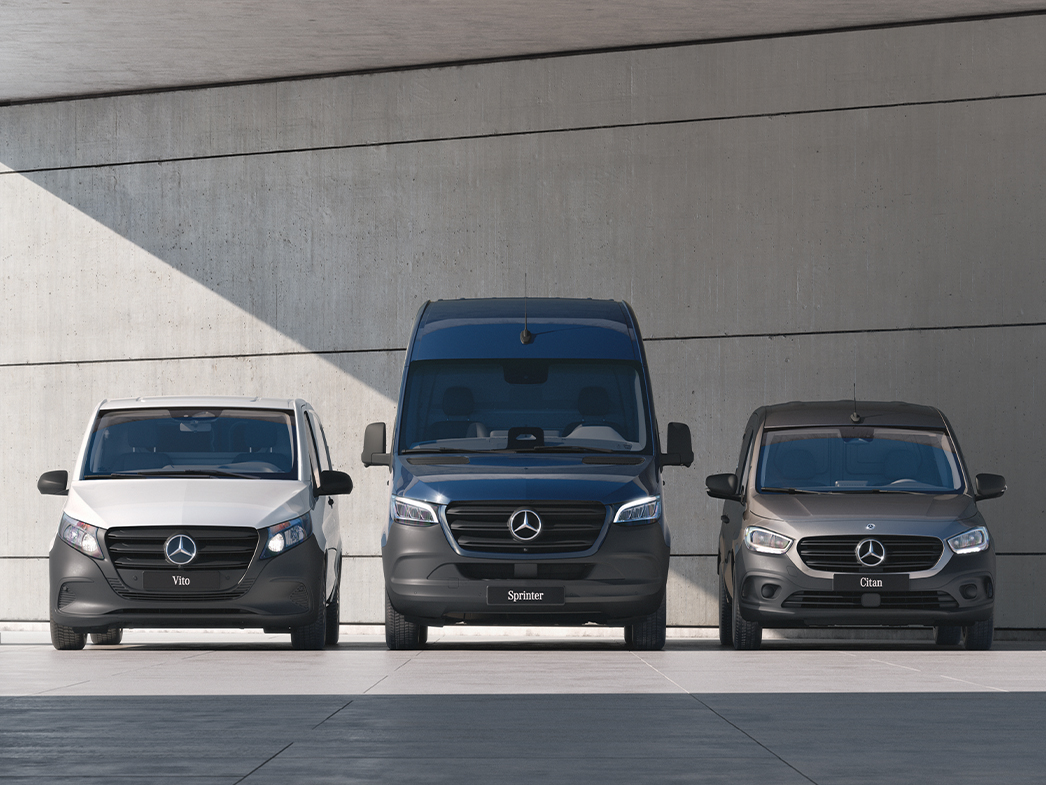
•The eSprinter Panel Van has a combined WLTP range of up to 272 miles and rapid DC charging up to 80% in just 34 minutes.

•The eSprinter Chassis has a combined range of up to 274 miles and rapid DC charging up to 80% in 34 minutes.

• The mid-sized eVito Panel Van’s combined WLTP range is 160 miles, and with DC rapid charging can go from 0-80% in just 35 minutes.

• The eVito Tourer is ideal for passenger transport with an impressive combined WLTP range of 228 miles. It can be charged from 10-80% in 40 minutes using DC charging.
 

• The new eCitan Panel and Crew Van are our compact electric vans with a combined WLTP range of up to 176 miles and rapid DC charging up to 80% in just 35 minutes.

Tips for maximising your electric van’s range 

It’s easy to extend the range of your electric van even when you’re on the move.

• You can top up at any of the UK’s current 42,000+ public charging points, which are situated at convenient locations like supermarkets, car parks and fuel stations.

• All Mercedes-Benz electric vans have 4 recuperation modes which can be used while driving to optimise battery life, with Economy Plus mode helping you to maximise your remaining range with just the flick of a switch.

• The motors inside electric vans also act as generators, converting forward motion back into energy when braking or driving downhill to improve their range – this is called ‘regenerative braking’.

• And with free integrated Digital Extras you can easily view your electric van’s remaining capacity and charge levels, as well as optimising routes to include charging points.

How to adapt your driving style to maximise battery range

• Avoid unnecessary acceleration and braking as this depletes the battery’s energy faster.
 

• Avoid driving any faster than you need to – it may sound obvious, but managing your speed can extend your van’s range.

• Whenever it’s safe, try to avoid coming to a complete standstill by anticipating junctions and roundabouts and keep moving where you can clearly see there isn’t any traffic.

• Make the most of your van’s regenerative braking (see above) by getting into the habit of using the recuperation mode to slow you down rather than braking as this will feed the energy back into the battery.

• As well as your driving style, you can also conserve energy by removing anything you don’t need from your van’s cargo area as the extra weight will reduce your range.

• Using the air conditioning or heating can also reduce your van’s battery, so if you need to extend your range, go easy on the temperature. 


Evaluating the costs of owning a commercial electric van

When buying an electric vehicle, it’s important to consider both the initial purchase price alongside the long-term savings. Electric vans may have a higher upfront cost, but the fuel and maintenance savings can be significant. This means they usually have a lower total cost of ownership when compared to diesel or petrol vans, saving you and your business money in the long-term. Charging costs depend on whether you charge at home or use public charging stations, with home charging being more affordable. By understanding these electric vehicle costs, you can better assess the overall ownership experience and ensure it aligns with your budget. Explore our comprehensive guide on electric vans running costs to discover how to maximise your savings.

Analysing resale value and finance options available

Alongside considering purchase price and potential savings, evaluating resale value and financing options is also essential for electric van buyers. Electric van resale value will be influenced by factors like technology and battery life. Various financing plans, such as leases and hire purchases, make managing the upfront cost easier. Choose a plan that fits your budget and business needs.

You can use our free valuation tool to discover your vehicle’s worth or explore our available finance products.

What does an electric van feel like to drive?

One of the unexpected bonuses of driving an electric van is the quieter, smoother and more responsive feeling you get from being behind the wheel.

With no clutch or conventional gearbox, electric vans move through the gears automatically and effortlessly. With fewer components, the engine is much quieter, and you get instant torque and acceleration, which gives you a greater feeling of control.
 

Mercedes-Benz electric vans also feature regenerative breaking which enables the vehicle to capture energy generated at braking, which is then fed back into the battery to extend range. This takes a little getting used to, but this soon becomes intuitive and, overall, it’s an intelligent way to maximise the battery range.
 

If you haven’t driven one yet, we recommend speaking to your nearest Mercedes-Benz Vans Dealer and arranging a test drive.

Protecting your electric van with the right insurance

Having the right insurance protects your electric vehicle and investment. Insurance costs depend on factors like the van’s value, usage, and the driver’s history. Choosing the right coverage ensures financial protection and compliance with legal requirements. You can read about our van insurance options on our dedicated guide.

Our van insurance options

Electric vehicles frequently asked questions

Yes, all our range is 100% electric. We do not offer hybrid vehicles. One advantage of fully electric vans is that they are more likely to qualify for electric vehicle grants and subsidies.

Until recently, electric vans were best suited to businesses that operate in cities, typically transport light loads or make ‘last mile’ deliveries, and have the ability to charge their vans overnight. However, as battery technology improves, the scope of businesses that are suitable for electric vans is expanding fast. For example, our latest eVito model has a WLTP range of 160 miles and can be recharged to up to 80% of full usable capacity in just 35 minutes using a 80kW rapid DC charger.


Many larger fleet operators and customers such as Travelodge and Amazon have introduced electric vans as a percentage of their fleet, to cover local routes and transfer employees from place to place.


As infrastructure improves and technology develops, it is likely that almost every business will have electric vans making up some part of their fleet. Some forward thinking small-to-medium sized businesses such as North London Recycler First Mile have also begun to introduce electric vans.

With the latest battery technology and extended range, electric vans are now capable of performing the ‘people carrier’ role. Our eVito Tourer has a range of up to 228 miles.

Every business places different demands on their vehicles, so it depends on factors such as your daily mileage, average payload and the type of driving you do (electric vans are generally not as well suited for long motorway journeys with heavy loads). However, the gap between electric performance and diesel or petrol is narrowing, and the overall running costs of electric vans are now lower. Government grants can reduce the purchase costs too by up to £5,000 so the economic arguments for electric vans are getting stronger all the time.

The amount of weight you’re carrying will affect your electric van’s battery range. For smaller vans, this is less of an issue due to the overall power/weight ratio but for large vans it may have a more limiting effect on range. An unloaded electric van typically weighs a little more than an unloaded diesel van, due to the weight of the battery packs in an electric van. This means that an electric van’s maximum payload is generally less than that of an equivalent diesel model – talk to one of our expert dealers to optimise your payload – we can often help you improve your current racking or fit out for lightweight solutions. 

Low temperatures do have some impact on the effectiveness of electric vehicle batteries. This is because batteries rely on chemical reactions to absorb and release electricity. Low temperatures slow down these reactions, which in turn reduces the battery's performance.


Another factor that affects battery range is the use of the electric heating system to warm up the interior, as this uses power from the same source that powers the electric drivetrain.


Although the cold does negatively affect electric vans, improvements in battery technology are starting to address this and with faster charging times and better infrastructure, it’s now easier to quickly restore your van’s battery levels and get back on the road.

Internationally, there are four common EV range tests: the EPA, WLTP, NEDC, and the new Chinese standard CLTC. WLTP (Worldwide Harmonised Light Vehicle Test Procedure) was introduced in 2017 and is the legal requirement for vehicles sold in Europe, as it is believed to be closer to actual day-to-day usage than the old NEDC, which is not in wide use anymore. Always compare vehicles using WLTP. Some manufacturers try to improve their perceived range by quoting NEDC figures or WLTP City figures – WLTP city shows the range at low speed, and is higher than the WLTP combined value – which is the standard for comparisons. For more information, view our WLTP page

All information is correct at time of going to press – 10/2024. Please note, Government grants and schemes and electricity prices can quickly change. Whilst every effort has been made to keep the page content as up to date and accurate as possible, please refer to the relevant Government sites for the latest information. Or speak to your preferred authorised Mercedes-Benz Dealer.